
Your enterprise has experimented with Large Language Models, but the results are inconsistent. Hallucinations undermine trust, static knowledge becomes quickly outdated, and the cost of continuous fine-tuning is prohibitive. This is the operational gap where a powerful new architecture is proving its strategic value: RAG AI. Retrieval-Augmented Generation is more than a technical patch; it is a fundamental shift in how intelligent systems access, process, and utilize your proprietary information securely and in real-time.
This guide moves beyond academic definitions to provide a clear enterprise framework. We will dissect the RAG architecture, demonstrating how it delivers trustworthy, context-aware AI that operates on your internal data. You will gain a clear model for evaluating RAG against fine-tuning, understand the path to scalable implementation, and see how this technology becomes the foundation for more advanced, autonomous AI systems. Prepare to transform your AI strategy from experimental to essential.
Key Takeaways
Table of Contents
What is RAG AI and Why Does it Matter for Business?
Large Language Models (LLMs) offer transformative potential, yet they operate with a fundamental disconnect from your enterprise reality. This creates a critical 'trust gap' that hinders true adoption and ROI. Retrieval-Augmented Generation, or RAG AI, is the architectural solution designed to close this gap. It is a framework that grounds powerful AI in your company's proprietary, up-to-the-minute data, making it a secure and reliable asset for your operations.
In essence, RAG connects powerful LLMs to verifiable knowledge sources. This transforms a generic model into a bespoke intelligence engine that understands the specific context of your business. It is the foundational layer for building the reliable, context-aware AI applications that drive operational excellence.
The Problem with Out-of-the-Box LLMs
Deploying a standard LLM for business-critical tasks introduces significant risk. Their core limitations prevent them from being a trusted source for enterprise decision-making:
How RAG Solves the Enterprise Trust Problem
The RAG AI framework provides the necessary strategic control by systematically addressing these limitations. The methodology, whose core concepts are detailed in Wikipedia's explanation of RAG, retrieves relevant information from a specified knowledge base before generating a response. This simple but powerful process delivers immediate business value:
RAG vs. Fine-Tuning: A Strategic Choice for Enterprise AI
Deploying large language models within the enterprise is not a monolithic task. The most critical decision is how you connect the model to your proprietary data. This choice between Retrieval-Augmented Generation (RAG) and fine-tuning is a strategic one, directly impacting your project's ROI, scalability, and long-term viability. It determines whether your AI becomes a dynamic, reliable asset or a static, quickly outdated tool.
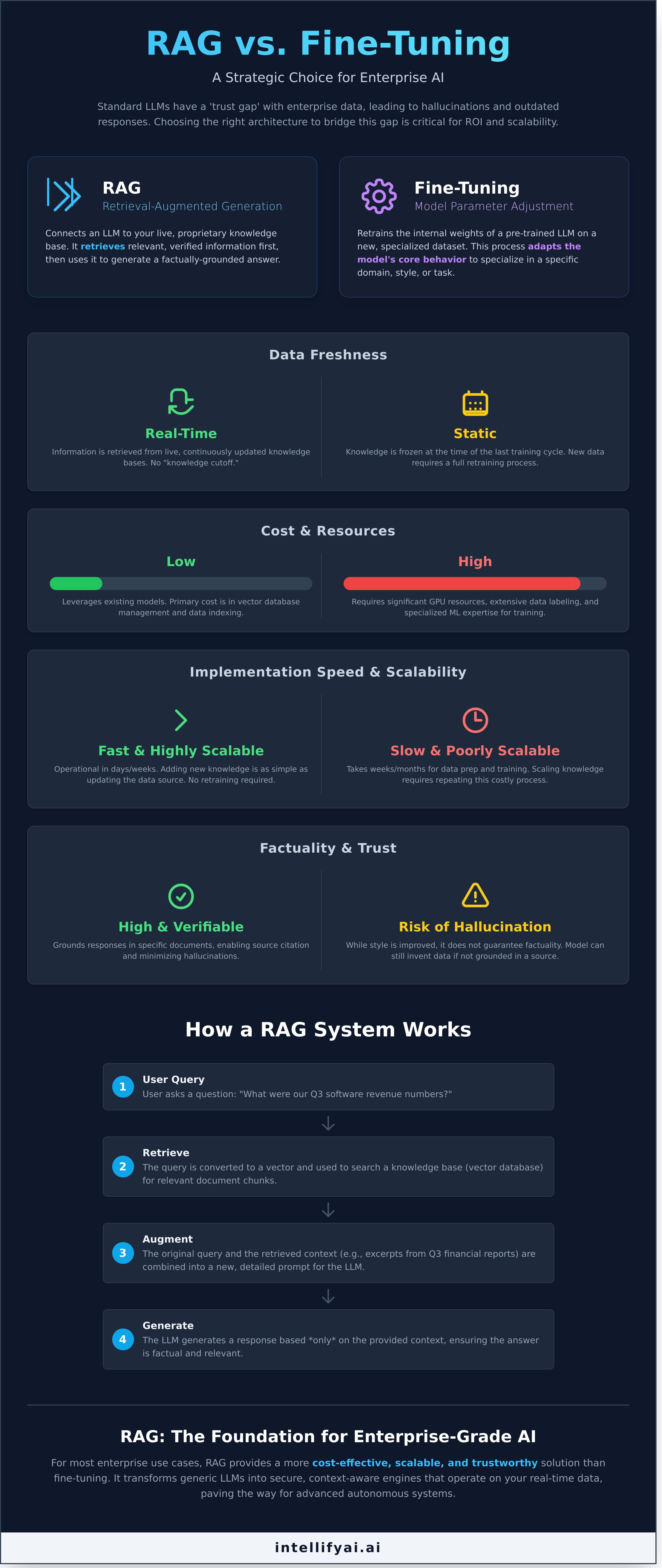
To make an informed decision, leaders must understand the distinct operational and financial implications of each approach. The following table provides a clear, top-level comparison for strategic planning.
Factor
Retrieval-Augmented Generation (RAG)
Fine-Tuning
Low. Leverages existing models; primary cost is in vector database management and data indexing.
High. Requires significant GPU resources, extensive data labeling, and specialized ML expertise.
Fast. Can be operational in days or weeks by connecting to existing enterprise data sources.
Slow. A resource-intensive process taking weeks or months for data preparation and model training.
Real-time. Information is retrieved from live, continuously updated knowledge bases.
Static. Knowledge is frozen at the time of the last training cycle, leading to "knowledge cutoff."
High. Adding new knowledge is as simple as updating the external data source. No retraining required.
Low. Requires retraining the entire model to incorporate new information, a costly and complex task.
High. Grounds responses in specific documents, enabling source citation and reducing hallucinations.
Variable. Prone to confabulation or "hallucination," inventing facts based on learned patterns.
When to Consider Fine-Tuning
Fine-tuning is the correct strategy when the objective is to change an LLM's fundamental behavior, not its knowledge. Its purpose is to teach the model a new skill, a specialized format, or a distinct communication style. For example, an organization might fine-tune a model to adopt its specific brand voice for marketing copy or to generate code in a proprietary programming language. However, it is an expensive, slow process that does not solve the critical problem of stale data.
When to Implement RAG
Implement RAG when your goal is to equip an LLM with specific, current, and verifiable information. This makes a rag ai system the superior choice for dynamic, fact-based enterprise applications. An intelligent customer support bot, for instance, can use RAG to access the latest product manuals and provide accurate, up-to-the-minute answers. The power of RAG lies in its decoupled architecture; the model’s reasoning capabilities are separate from the knowledge base it accesses. This Core Architecture of a RAG System ensures operational efficiency, real-time accuracy, and seamless scalability.
The Core Architecture of a RAG System: A Blueprint
To achieve operational excellence, a Retrieval-Augmented Generation system operates on a clear, logical workflow. This is not just a sequence of technical steps; it is a strategic process designed to transform your proprietary data into an interactive, intelligent asset. The entire architecture of a rag ai system can be distilled into a seamless, four-stage blueprint that moves from raw data to a precise, context-aware response.
Stage 1: Data Ingestion & Indexing (The Knowledge Base)
First, the system connects to your designated enterprise data sources, whether they are document repositories, internal databases, or live APIs. To prepare this information for retrieval, it is broken down into manageable, logical "chunks." Each chunk is then passed through an embedding model, which converts the text into a numerical vector. This vector embedding is a sophisticated digital fingerprint that captures the core semantic meaning of the information, making it instantly understandable to the AI.
Stage 2: The Retrieval Process (Finding the Facts)
When a user submits a query, it undergoes the same embedding process, creating a query vector. The system then uses a specialized vector database to perform a high-speed similarity search. Instead of matching keywords, it matches the meaning behind the query with the meanings of the indexed data chunks. This is semantic search in action-a powerful technique that finds the most contextually relevant information, even if the wording doesn't match exactly.
Stage 3 & 4: Augmentation and Generation (The Smart Response)
This final phase is where the intelligence is synthesized. The most relevant data chunks identified during retrieval are automatically compiled and attached to the user's original prompt. This augmented prompt, now rich with factual context, is sent to a Large Language Model (LLM). The LLM uses this provided information as its single source of truth to generate a final answer. The output is an accurate, verifiable response that is directly grounded in your organization’s data, eliminating hallucinations and building trust in your AI solution.
Key Considerations for Implementing RAG in Your Enterprise
Transitioning Retrieval-Augmented Generation from a theoretical model to a production-ready enterprise asset requires disciplined architectural planning. A successful deployment hinges on a clear-eyed assessment of your data, technology, and operational realities. Asking the right questions at the outset is critical to building a system that is not only intelligent but also secure, scalable, and cost-effective.
Data Quality and Governance
The adage 'garbage in, garbage out' is amplified in RAG systems. The relevance and accuracy of your AI's responses are directly tied to the quality of your source knowledge, demanding a commitment to clean, well-structured, and up-to-date data. Furthermore, robust governance is non-negotiable. Your system must enforce existing access controls, ensuring the AI only retrieves information that a specific user is authorized to see, thereby maintaining enterprise-grade security and compliance.
Choosing Your Technology Stack
A high-performance rag ai architecture is a composite of several critical components. Key decisions involve selecting the right Vector Database for storing and querying data embeddings, the optimal Embedding Model to convert text into numerical representations, and the most capable Large Language Model (LLM) for synthesizing answers. The choice between open-source control and managed-service efficiency must align with your team's capabilities and budget. Designing for modularity is paramount to future-proof your investment, allowing you to upgrade components without re-architecting the entire system.
Performance, Scalability, and Cost
Operational excellence depends on balancing three interconnected factors. You must optimize for retrieval accuracy without introducing unacceptable response latency for the end-user. Your architecture must be designed to scale seamlessly as both your knowledge base and user query volume grow. Finally, a clear understanding of cost drivers-including data indexing, vector storage, and recurring LLM API calls-is essential for managing ROI and ensuring the long-term economic viability of your implementation.
From RAG to Agentic AI: The Future of Autonomous Workflows
Retrieval-Augmented Generation is more than a mechanism for accurate Q&A; it is the foundational technology for the next frontier in enterprise automation: Agentic AI. While RAG grounds language models in your specific reality, autonomous agents use that grounding to take action. This evolution marks the critical shift from conversational AI to operational AI, where intelligent systems actively participate in and orchestrate complex business workflows, driving a new standard for efficiency.
Why RAG is the Engine for Agentic AI
An autonomous agent must perceive its environment, reason about its goals, and execute tasks. In an enterprise context, that "environment" is your complex ecosystem of proprietary data-from financial reports and customer databases to internal wikis and real-time operational metrics. RAG provides this critical perception layer. It gives an agent the reliable, context-aware "sight" it needs to make informed decisions and act with precision. Without it, an agent is disconnected from business reality, rendering its actions unreliable.
A powerful rag ai framework ensures that every action an agent takes is based on verified, up-to-the-minute corporate knowledge. Consider an agent tasked with preparing a pre-meeting sales brief. It can leverage RAG to:
Based on this multi-source synthesis, the agent can autonomously generate a comprehensive brief and distribute it, executing a workflow that previously required hours of manual effort.
Building Your Enterprise AI Future with IntellifyAi
The transition from a conceptual understanding of RAG to a deployed, secure Agentic AI solution requires deep architectural expertise. This is where IntellifyAi delivers strategic value. We specialize in engineering the robust, scalable RAG foundations that empower true autonomous workflows, moving your organization beyond simple chatbots to sophisticated, task-oriented agents.
Our approach moves beyond academic proofs-of-concept to deliver enterprise-grade intelligent automation. We design systems that are not only powerful but also trustworthy, secure, and seamlessly integrated into your existing technology stack. Our expertise in bespoke integration ensures your AI agents can interact with your proprietary systems, from CRMs to ERPs, unlocking their full operational potential and delivering measurable ROI.
Ready to move from data retrieval to autonomous action? Explore how IntellifyAi can architect your enterprise-grade Agentic AI future.
RAG AI: The Foundation for Your Intelligent Automation Strategy
As we have established, Retrieval-Augmented Generation is more than a technical architecture; it is a strategic pillar for enterprise intelligence. By grounding large language models in your proprietary data, rag ai provides a scalable and cost-effective alternative to fine-tuning, delivering contextually aware and accurate results. This powerful approach is not merely an endpoint but a critical foundation for the next evolution of business process automation: sophisticated, autonomous agentic workflows that drive unprecedented operational excellence.
However, the transition from concept to execution demands a partner with proven expertise. IntellifyAi specializes in engineering enterprise-grade Agentic AI, leveraging robust frameworks to translate complex technology into measurable business outcomes. We don't just implement tools; we architect bespoke intelligent automation systems that future-proof your operations and liberate your team to focus on high-value, strategic work. This is the core of Human-AI synergy.
The future of your enterprise is not just automated; it is intelligent. Partner with IntellifyAi to build your enterprise AI strategy.
Frequently Asked Questions
What is the main difference between RAG and a standard LLM?
A standard LLM generates responses based solely on its internal training data, which is static and can be outdated. RAG enhances an LLM by dynamically retrieving relevant, current information from a specified external knowledge base before generating an answer. This grounds the AI's response in verifiable, enterprise-specific data, transforming it from a generalist tool into a specialized, high-precision asset for your business.
Is RAG AI better than fine-tuning a model?
The choice between RAG and fine-tuning depends entirely on the strategic objective. RAG excels at infusing the model with new or domain-specific factual knowledge without costly retraining, making it ideal for dynamic information environments. Fine-tuning is superior for teaching the model a new skill, tone, or complex reasoning style. For ultimate performance, these methods can be combined to create a bespoke solution that is both knowledgeable and stylistically aligned with your brand.
What are the key components of a RAG system?
A RAG system is built on three core components that enable intelligent automation. First, a Data Indexing pipeline processes and stores your knowledge base, often in a vector database. Second, a Retriever module performs a high-speed semantic search to find the most relevant data for a given query. Finally, a Generator, which is the LLM, synthesizes the user's query and the retrieved context to produce a precise, fact-based, and actionable answer.
What are some real-world examples of RAG in business?
RAG delivers measurable ROI across multiple business functions. Consider an intelligent customer support agent that resolves complex queries by referencing the latest product manuals, drastically reducing ticket times. Another example is an internal HR chatbot that provides employees with instant, accurate answers based on company policy documents. In finance, RAG can power tools that synthesize real-time market reports to provide analysts with immediate, data-driven insights for strategic decision-making.
How does RAG help to reduce AI hallucinations?
AI hallucinations occur when a model fabricates information due to a knowledge gap. RAG directly mitigates this critical business risk by grounding the LLM in factual data. Before generating a response, the system retrieves verified information from your enterprise knowledge base. This context acts as a factual anchor, compelling the AI to base its answer on provided evidence rather than its internal, generalized training. This process ensures outputs are reliable and safe for enterprise use.
What is a vector database and why is it important for RAG?
A vector database is a specialized system designed to store and search data as high-dimensional vectors, or embeddings. It is the foundational technology for RAG's retrieval component. Unlike traditional databases that match keywords, a vector database enables semantic search-finding information based on conceptual meaning and context. This allows the RAG system to instantly locate the most relevant documents, ensuring the LLM receives high-quality, precise information to generate its answer.
Can RAG work with any type of data?
RAG architecture is engineered for versatility and can be integrated with nearly any enterprise data source. It effectively processes unstructured data like PDFs, documents, and emails, as well as structured data from databases and APIs. The initial ingestion and embedding process standardizes these diverse formats into a searchable index. This adaptability makes RAG AI a transformative solution, capable of unlocking the full value of your entire proprietary knowledge repository, regardless of its original format.
How do you measure the performance of a RAG system?
Measuring the performance of a RAG system requires a two-pronged approach focused on operational excellence. We evaluate the Retriever using metrics like precision and recall to ensure the most relevant documents are being surfaced. We then assess the Generator on its faithfulness-its ability to adhere strictly to the provided context-and its overall answer relevance. A combination of automated evaluation frameworks and structured human feedback provides the data needed for continuous optimization and peak performance.








.svg)